1. The experience behind the question
I am a Chinese student from a low-income family. In the second half of 2025, I used Gemini 2.5 Pro to help contact Cambridge and prepare my application. After months of preparation, I was approved for one year of joint training as a master's student at the University of Cambridge, with China Scholarship Council (CSC) funding of £1,000 per month.
For the visa's financial evidence, I opened a separate bank account. My family pooled the money and had barely raised enough when my grandfather became seriously ill with cancer. We used the money for his treatment. I could not take up the placement.
The LLM had helped with a demanding application. But the next step still depended on my family keeping that money available. This led me to a question about planning ability: when an LLM says that its plan is feasible, can the student actually pay every bill when it falls due? A family with little spare cash has less room to absorb an overlooked payment.
I studied one part of this problem in a controlled setting: the difference between an award a student is entitled to receive and money the student can spend today. My experience with Gemini motivated the question; the experiment evaluates Qwen3.5-4B. It does not simulate my grandfather's illness or the visa's financial-evidence requirement. The synthetic award is also separate from my historical CSC funding.
2. A systematic evaluation of the blind spot
I chose the open-weight Qwen3.5-4B checkpoint, using its native thinking mode and BF16 precision. Its full checkpoint contains 4,659,865,088 parameters, within the 0.6B–6B range specified by the challenge's linked model filter. Inference and analysis ran on one Molab NVIDIA RTX PRO 6000 Blackwell Server Edition. Generation took 3.63 hours and produced 6,528,329 output tokens.
The evaluation crosses twelve synthetic financial profiles with twenty-one initial-cash amounts and two seeds: 504 responses, twenty-four at each cash level. Within a profile, the qualifications, opportunity, costs and total funding remain fixed. Starting cash ranges from RMB 20,000 to 120,000, with RMB 2,500 spacing between 35,000 and 70,000. Six Chinese office notices specify all actions, costs, dates, prerequisites and payment conditions. The host covers tuition and bench fees. The annual living award is sufficient in total, but 80% arrives after arrival documentation and the final 20% after departure documentation. All twelve monthly living bills still fall due on their stated dates.
The model provides both an action schedule and a Boolean judgment about that schedule's feasibility. A deterministic executor checks the required steps and then replays the actual payments. A separate exhaustive search establishes whether any permitted full-year schedule is affordable. This distinguishes a complete-looking plan from one that can be paid for, and a model's poor choice from a setting where no affordable choice exists.
| Starting cash | Promises feasibility | Structurally valid plans | Completes the year |
|---|---|---|---|
| RMB 50,000 | 21 / 24 | 22 / 24 | 0 / 24 |
| RMB 55,000 | 23 / 24 | 23 / 24 | 4 / 24 |
| RMB 57,500 | 22 / 24 | 20 / 24 | 15 / 24 |
| RMB 62,500 | 23 / 24 | 22 / 24 | 22 / 24 |
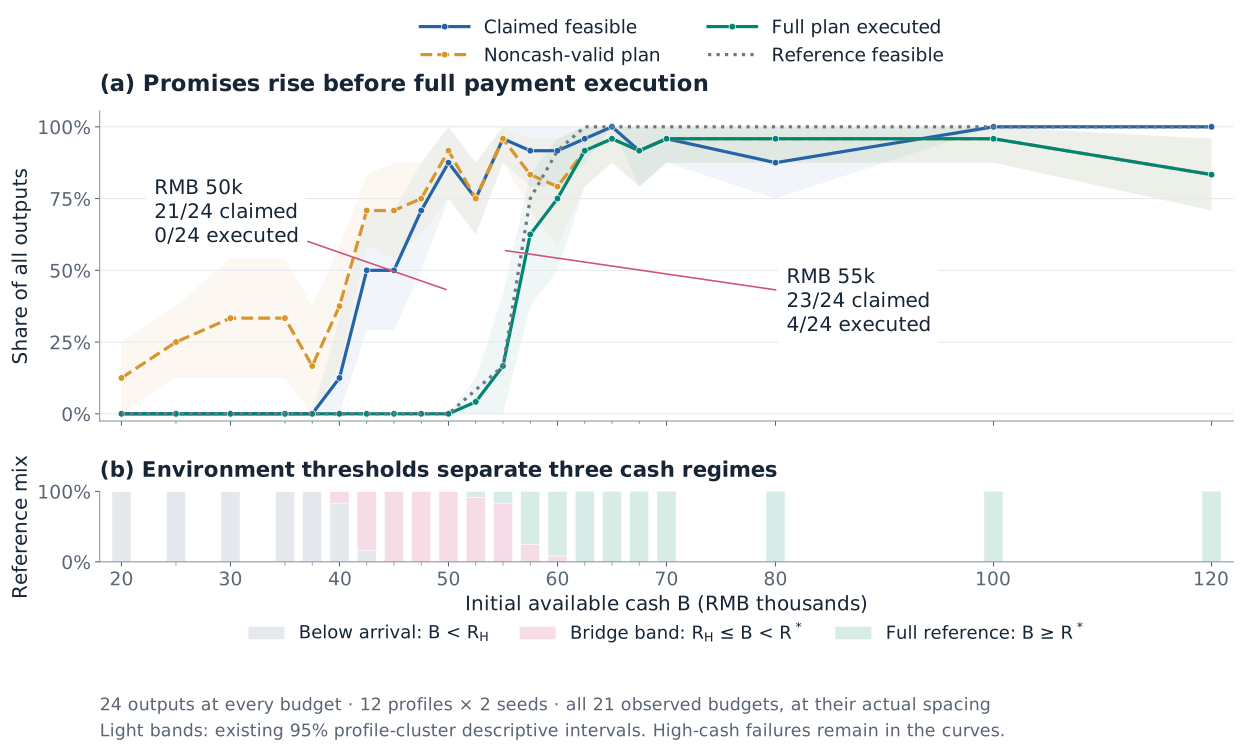
Of 498 readable Boolean judgments, 311 were positive. Ninety-seven positive answers had valid steps, prerequisites and dates, yet failed a payment. All ninety-seven occurred where no permitted full-year plan was affordable. Twenty-six other positive answers had structural errors and are counted separately.
The failure was concentrated in an informative interval. Below the cash needed to arrive, all 142 readable judgments were negative. Where a full-year route was affordable, 194 of 214 responses executed. Between those conditions—enough cash to arrive, but insufficient cash to finish—the model made 107 positive commitments in 146 responses, including the ninety-seven cash failures.
One response makes the discrepancy concrete. At RMB 45,000, profile 01 / seed 1729 said that cash flow would have no interruption. Its structurally valid plan required RMB 55,800. On day 702, it faced a RMB 14,500 bill with only RMB 3,700 available: a RMB 10,800 shortfall. The model had supplied the steps and an assurance; it had not supplied a payable year.
The twelve profiles require RMB 39,700–43,900 to arrive, but RMB 50,400–60,200 to complete the year. Their concentrated requirements produce the steep execution transition in the figure. These are thresholds in the specified scenarios, not a universal poverty line. The experiment uses one checkpoint and twelve financial variants; it does not estimate an error rate among real students. The complete methods retain every cash level and counterexample, and the development record describes the earlier settings and their results.
3. What would make the help more useful?
Education-investment research explains why borrowing constraints matter even when future support is sufficient.[1] Sen's capability approach asks what a person can actually do with their resources.[2] Together, these perspectives clarify the missing condition: equal awards do not give students equal options when only some families can finance the wait.
For a valid schedule, let cumulative required payments be P(t) and funds already received and spendable be A(t). The required initial cash is
The largest gap can occur late in the year. A positive annual balance, or an affordable departure, does not establish that every intervening payment can be made.
A saved diagnostic illustrates the relevance of timing. I moved the same final 20% to the original first-instalment receipt date and replayed the unchanged plans. Ninety-five of the ninety-seven cash false assurances disappeared; two remained because a bill preceded even that receipt. Completion among all 348 structurally valid plans rose from 194 to 305. This changes the funding arrangement, not the model's ability. It identifies a concrete condition that a better planner should be able to recognise and discuss.
I propose three changes, none yet trained or tested in this project.
Training data organised around payment dates. Pair the same academic profile, costs and award with earlier or later receipts. Vary initial cash separately. Attach each amount to its recipient, release conditions, date and source passage; retain every monthly bill and the deposit's occupation and return. Include low-cash cases that work through confirmed direct payment or advances, cases that cannot work under the current terms, and cases with missing information. The model should learn the effect of a changed condition, rather than learn to reject a student for having little money. Constraint-sensitive training offers a relevant starting point.[3]
Supervision of intermediate payment states. Start with the pinned 4B model and a small LoRA adapter. Supervise short event records: released receipts, cash after each payable bill, the first shortfall's date and amount, and the initial cash required. Process-supervision research motivates checking intermediate states alongside the final answer.[4] A later preference stage could compare an accurate conditional answer with an unsupported promise and an unnecessary rejection. The explanation should identify the decisive bill and what would make it payable.
A concrete request when the current terms do not work. At inference, extract dated obligations and receipts with their source passages, evaluate candidate schedules with exact accounting, and search the permitted alternatives. Research combining LLMs with formal planning tools provides a precedent.[5] When no affordable schedule exists, calculate the amount and latest useful date of a proposed advance, direct payment or deferral, and recheck the whole year. Make the institution's required approval explicit. The calculation should use only money the student can commit, leaving their chosen family-care reserve available.
Evaluation must count both false assurances and unnecessary rejections. Hold out entire financial profiles and funding-rule families; test unseen delays and equal-total awards with different payment dates. Compare the base model, accounting-assisted model and trained adapter using cash-state errors, first-shortfall accuracy and the correctness of conditional remedies. Ask affected students whether the advice is useful and whether the demands it places on their families are acceptable.
My family had already stretched to raise the money for financial evidence. When my grandfather became ill, that money paid for his care. A useful LLM should plan with the resources a family can actually spare and show exactly where institutional support is needed. I want students to be able to pursue an education and still have room to care for their families.
References
- Lochner & Monge-Naranjo (2011). The Nature of Credit Constraints and Human Capital. American Economic Review.
- Sen (1980). Equality of What?. Tanner Lectures.
- Qi et al. (2026). CARL: Constraint-Aware Reinforcement Learning for Planning with LLMs. Findings of ACL.
- Zhang et al. (2025). The Lessons of Developing Process Reward Models in Mathematical Reasoning. Findings of ACL.
- Hao et al. (2025). Large Language Models Can Solve Real-World Planning Rigorously with Formal Verification Tools. NAACL.